
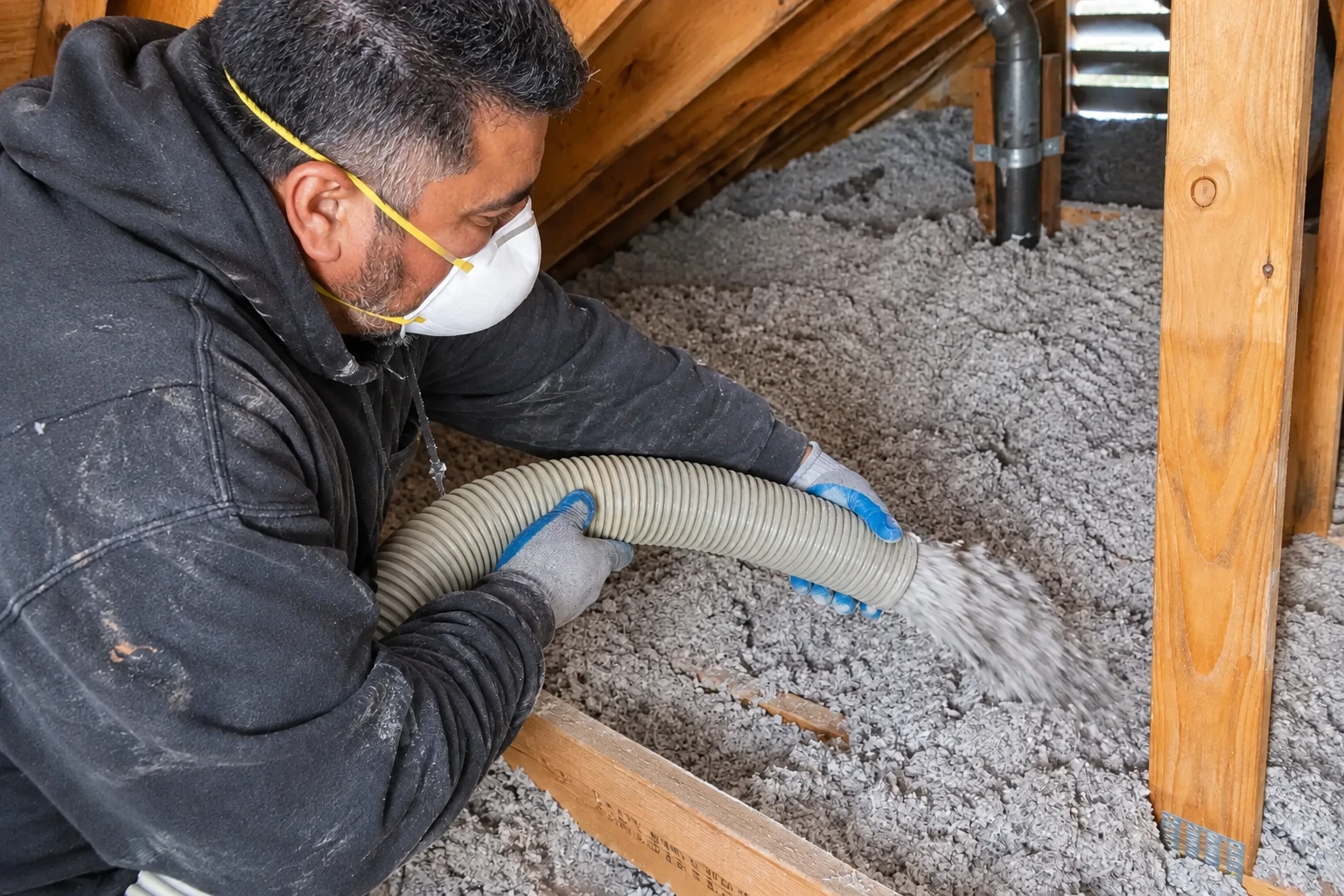
Blown-in insulation in Petaluma CA - even coverage that fills every corner
Hot upstairs and drafty below, with a thin layer in the attic? We blow loose fill in thick and even so the house stays comfortable.
Get your attic and walls looked at
We pick up evenings and weekends, so calling (707) 238-6044 after work is fine.
Should you blow insulation into your attic, your walls or both?
Blown-in insulation is loose fill blown through a hose onto your attic floor or into closed walls, and for Petaluma houses it's how we fill the odd corners and pack it tight around the wiring, pipes and framing in the way.
Most of my calls come from older houses that are hot upstairs, drafty down below and running up the power bill, with a few tired inches in the attic and often nothing in the walls. The price moves with how much area we're filling, whether the old stuff has to come out first and how many gaps need closing up with attic air sealing before any fill goes in. The schedule turns mostly on whether your job needs a permit and how easy it is to get into the attic or walls, and the estimate I write after looking gives you your own number.
Why Petaluma homeowners call Evergreen Petaluma Spray Foam Insulation for blown-in work
I climb up there myself
I go up in your attic, write the estimate and check the finished work with you, and our crew lead and installers do the blowing. Your answers come from the person who actually looked.
A family trade since 2017
I learned the trade from my dad in attics and crawl spaces around Petaluma and started this business in 2017. He taught me to seal before we fill, which is what makes insulation pay off.
Licensed and fully insured
California's contractors board treats installing any insulating material for heat or sound as its own kind of contracting. Ask every contractor you're comparing about their license and insurance, ours included.
What matters most on this job is fill that's just as deep at the edges as in the middle, and the only way to know what you've got is to look. Reach me through our contact page and I'll come up and see.
How we do blown-in insulation in Petaluma
First I look at what's already up there, because fresh fill over soaked or dirty insulation just buries the trouble. Then we seal the gaps around can lights, pipes and the hatch, and we set baffles at the roof edge, guides that keep insulation out of the eave vents so the attic keeps breathing. We also block off clear space around flues and exhaust fans. We blow it in thick and even so it fills the odd corners and packs around whatever's in the way, dense enough to resist settling and just as deep out at the edges as in the middle, which is where a lot of jobs come up short. Before we touch any walls, I ask about the age of the house and its wiring. Your satisfaction, guaranteed.
A lot of the time, blown-in fill is one part of bigger home insulation work on an older house, alongside the walls and the crawl space. When the old layer is wet or nested in, we start with insulation removal so the new fill goes onto a clean ceiling.
Topping up the attic you have
Suits an attic where the old layer is dry and clean but thin or patchy. We seal the gaps, then blow new fill right over it out to the edges.
A fresh start after removal
Suits an attic where the old stuff got wet or turned into a mouse hotel. It all comes out first, so the new layer starts on a clean, dry ceiling.
Filling closed walls
Suits an older house with empty outside walls you'd rather not open up. How we go about it depends on the house's age and wiring, so that talk comes first.
How do you know your attic needs more insulation?
Hot rooms upstairs
The upstairs bakes on warm afternoons and stays stuffy into the night. That usually means the attic layer is thin or patchy, and the power bill pays for it every month you wait.
Joist tops showing through
If you poke your head in the hatch and see the tops of the ceiling joists, there isn't much left up there. Every season you put it off, heat slips straight through the ceiling.
Drafts around lights and hatch
Cold air at the can lights, the attic hatch or around pipes means gaps nobody sealed. Blow insulation over them as is and the draft keeps running right through the new layer.
Stains, smells or droppings
Damp spots, a musty smell or droppings in the old insulation mean it's past saving. Covering it just hides the problem, and moisture left up there works its way into the framing.
What happens when you call about blown-in insulation in Petaluma?
Call and set up a visit
Call or send the form and we'll set a time for me to come out. I go up in the attic, tell you what I see and write up the estimate.
Permit first, then the work
If your job needs a permit, that comes first, and in Petaluma most take a few weeks or even months. Then our crew lead and installers do the sealing and blowing.
We look it over together
When the crew's finished, I come back and we look at the attic together, edges and all. We don't call it done until you've seen it.
Questions about blown-in insulation
Here are the questions Petaluma homeowners ask most about blown-in insulation. If yours isn't here, call and ask me about your own attic or walls.
How much does blown-in insulation cost in Petaluma?
Blown-in insulation in San Francisco usually costs about $3 to $9 per square foot, and since that's a San Francisco figure, take it as a ballpark for here. Your own number comes from the estimate I write after I've been up in your attic.
Is blown-in insulation better than batts in my attic?
For most attic floors, yes, because blowing loose fill, whether fiberglass, rock wool or cellulose, usually costs less than laying batts and covers better. Batts leave gaps where they're cut around joists and wires, while loose fill fills those spots, though install costs can vary from one attic to the next.
Can you insulate my walls without tearing them out?
Usually, yes, with a fairly gentle method called drill and fill, where small holes go in near the top of each wall cavity and the fill goes in through them. The holes can be drilled from inside or outside, but from outside they break the drainage plane, the layer behind the siding that sheds water, so it has to be patched or replaced. From inside it stays untouched, so that's often the simpler choice, and we'll talk through which suits your house.
Can blown-in insulation go around knob-and-tube wiring?
No, the National Electrical Code doesn't allow insulation to be applied to or around knob-and-tube wiring, the old wiring strung on porcelain knobs. That's why the wiring question comes first. If your house was built before 1980, it's also worth knowing the lead safety rules before any walls get opened, and both things shape how the wall work gets done.
How do I find out if I need a permit for insulation in Petaluma?
Ask Petaluma's Building Division, which handles building permits in the city and answers project questions at building@cityofpetaluma.org. The city's permit list is only partial, and the city says all work has to meet the state building code and city codes whether it needs a permit or not. We find out what the city wants for each job and handle the permit when one's needed, and if we're not sure, we ask the building office before we start.
What is the best way to insulate an older house in Petaluma?
For most older houses, sealing the attic gaps and topping up with loose fill gives you the most for your money. Spray foam costs more but seals air while it insulates, so it earns its keep when your ductwork runs through the attic. I'd rather tell you what can wait than sell you the pricier job.
Get a blown-in insulation estimate
Tell us the age of your house, how you get into the attic and whether you know of any knob-and-tube wiring. We'll reply within one business day and set a time for my free on-site estimate, with no obligation.
Examples of blown-in insulation
Work that often goes with it
Home insulation
For drafty older houses where heat escapes through more than the attic, a whole-house look tells you which fixes are worth doing now and which can wait.
Learn moreInsulation removal
When the old attic layer is soaked, matted or chewed up by critters, clearing it out keeps that mess from staying trapped under fresh insulation.
Learn more